


 Our challenging and creative English curriculum aims to enable all pupils to achieve ambitious level of literacy. Children are provided with an exciting and innovative curriculum which promotes a love of reading and a belief that everybody is an author.
Children are exposed to high quality literature to inspire their own writing and to model engaging uses of the English language. Through the critique of these texts, children develop their oral comprehension skills. Imagination and originality are nurtured through exploration, discussion and drama. Spelling, punctuation, grammar and phonics teaching ensure that children have the skills and confidence to develop their writing style across a range of genres and in varied contexts.
We recognise the importance of communication and language development in achieving academic success in English. Therefore, oracy is at the heart of our curriculum. Children are immersed in a language rich curriculum that intends to give all pupils an extensive vocabulary and oral proficiency.
Our English Policies -
 Early literacy is the development of young children’s skills in moving from learning to read, to reading to learn; these skills include word recognition and language comprehension – the essential components of reading.
Children do not automatically learn how to read and skills need to be specifically taught. Providing high-quality learning experiences creates the necessary foundation to help children master essential early literacy skills.
Once children have these necessary foundations, their journey in reading continues through rich reading experiences that both engage and further develop their skills as reader.
Reading is at the heart of the Castlechurch curriculum with explicit learning through English curriculum experiences and implicit learning experiences through the whole school curriculum.
Reading Core Offer at Castlechurch 2022 On one page
EEF 7 Top Tips to Support Reading at Home
How Castlechurch Primary teaches phonics 

At Castlechurch Primary it is essential that our approach to teaching phonics and reading is accessible to all learners, regardless of background and that it promotes and fosters a life-long love of reading from the very beginning of their school journey.
We believe that all our children can become fluent readers and writers. This is why we teach reading through Little Wandle Letters and Sounds Revised, which is a systematic and synthetic phonics programme. We start teaching phonics in Nursery/Reception and follow the Little Wandle Letters and Sounds Revised progression, which ensures children build on their growing knowledge of the alphabetic code, mastering phonics to read and spell as they move through school.
Little Wandle Letters and Sounds Revised is a complete systematic synthetic phonics programme (SSP) developed for schools by schools. Based on the original Letters and Sounds, but extensively revised to provide a complete teaching programme meeting all the expectations of the National Curriculum, the Ofsted Deep Dive into reading and preparing your children to go beyond the expectations of the Phonics Screening Check.
We ensure that children progress in their phonic knowledge through:
- Daily phonic sessions
- Phonics being promoted as a tool to help children decode words to read and spell
- To support letter formation and spelling we use the Little Wandle rhymes to help children find and form the sounds they need when writing.
- Children are encouraged to use and apply their phonic knowledge in independent work, guided writing sessions and group reading 3 times a week.
- Regular assessments which are then used to inform planning and cover gaps
- Clear, high expectations and time scales are set within the progression of phonics – interventions are put into place for those children not meeting the expectations set. Keep up not catch up approach is led through our school.
- Reading books support and are closely matched to each child’s phonological awareness and level of development.
Please click here for a copy of our Phonics and Early Reading parents’ workshop PowerPoint
 Writing is an integral part of our curriculum that will enable pupils to write for a variety of purposes and audiences and to communicate effectively.
Children begin their writing journey through developing their physical ability (gross and fine motor skills), refining these enables them to begin to communicate through recognisable marks. From letters, to words, into sentences, children will become confident and fluent writers. They will plan, revise and evaluate their writing.
Writing is the fundamental tool which enables children to fulfill their curriculum outcomes, developing effective transcription and composition, showcasing a wide knowledge of vocabulary and grammar.
As with reading, writing is taught through both explicit learning in English and implicit learning through the wider curriculum to encourage enjoyment and purpose to writing.


Early Mark Making
Children begin to explore writing through mark making. Exploring shapes, lines and building up the motor skills children need to then begin to develop writing at a later stage.
Squiggle While You Wiggle
This is a physical approach to stimulate early writing. Children use movement with music to develop their motor skills in preparation for writing. In Nursery & Reception the children take part in squiggle whilst you wiggle sessions. First they paint each other to help them get familiar with the parts of the body. Then they will learn a new gross motor movement to a piece of music. They will dance using this movement and use it to make marks, this can be in foam, on paper, in sand etc. This is then developed into more fine motor skills to develop pinch and grip skills ready for developing writing later on. They will then use this action to think of letters they can form that use this shape. These sessions are great fun but most importantly help your child to be confident mark makers.
Funky Fingers
Following on from Squiggle, the children then explore developing fine motor skills, developing finger strength and accuracy by completing a variety of tasks using different equipment in our Funky Finger Activity Stations.


Development of Writing
30 to 50 months
At this stage the children sometimes begin to give meaning to marks as they draw and paint. They will also start to give meanings to marks that they see in different places.
40 to 60+ months

By now, the children are giving meaning to marks they make as they draw, write and paint. They begin to break the flow of speech into words and continue rhyming string. Focus will be on hearing and saying the initial sound in words. Before they begin to segment the sounds in simple words and blend them together. Next, they will make links sounds to letters, naming and sounding the letters of the alphabet. From this knowledge the will begin to use some clearly identifiable letters to communicate meaning, representing some sounds correctly and in sequence. Finally, they will be able to write most of the following; own name, labels and captions. Many children will also be able to attempt writing short sentences in meaningful contexts, such as using a picture to retell simply that part of a story.
Early Learning Goal for Writing 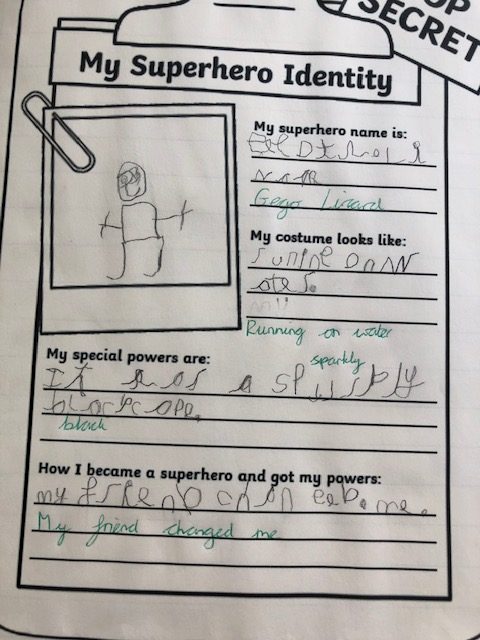
Children use their phonic knowledge to write words in ways which match their spoken sounds. They also write some irregular common words. They write simple sentences which can be read by themselves and others. Some words will be spelled correctly and others are phonetically plausible.
English Progression Documents
 The links below are Castlechurch's progression documents for reading, writing and speaking & listening.
EYFS
Castlechurch EYFS Writing Prog Doc
Castlechurch Reading EYFS Overview
KS1
Castlechurch Y1 Writing Prog Doc
Castlechurch Reading Overview Year 1
Castlechurch Y2 Writing Prog Doc
Castlechurch Reading Overview Year 2
LKS2
Castlechurch Y3 Writing Prog Doc
Castlechurch Reading Overview Year 3
Castlechurch Y4 Writing Prog Doc
Castlechurch Reading Overview Year 4
UKS2
Castlechurch Y5 Writing Prog Doc
Castlechurch Reading Overview Year 5
Castlechurch Y6 Writing Prog Doc
Castlechurch Reading Overview Year 6